Rules
Part of Sizing a monitor or television around signals, ports, and total cost
Blank screens, blur, or wrong color: monitor and TV troubleshooting basics
Monitor and TV troubleshooting for blank screens, dropouts, blur, wrong color, flicker, overscan, antenna faults, controlled tests, records, and safe service.
What to take away
- State the symptom precisely before changing settings or buying parts.
- Prove power, selected input, one source, and one direct known-good cable first.
- Use internal menus or self-tests to separate panel faults from incoming-signal faults.
- Reduce resolution, refresh, HDR, and adapters one at a time to find a bandwidth or compatibility limit.
- Back up settings and connected accounts before resets or service.
A screen can be blank because it has no power, the wrong input, a sleeping source, a failed cable, an unsupported mode, a receiver problem, or an internal fault. Randomly replacing parts creates new variables. A simple test matrix finds the boundary between working and failing states.
Stop for safety
Unplug and seek qualified guidance for smoke, sparks, a burning smell, liquid entry, exposed conductors, a cracked mains lead, severe heat, buzzing from damaged power equipment, or a physically unstable display. Do not open a television or monitor merely because it is unplugged. Internal circuits can retain hazardous energy.
Secure a loose or tipping display before further tests. Do not press, heat, twist, or massage a cracked or blotched panel. Handhelds earn the same restraint; see the tablet and e-reader display problems guide.
Name the symptom
Record the exact source, port, cable, mode, time, and visible behavior. Useful descriptions include:
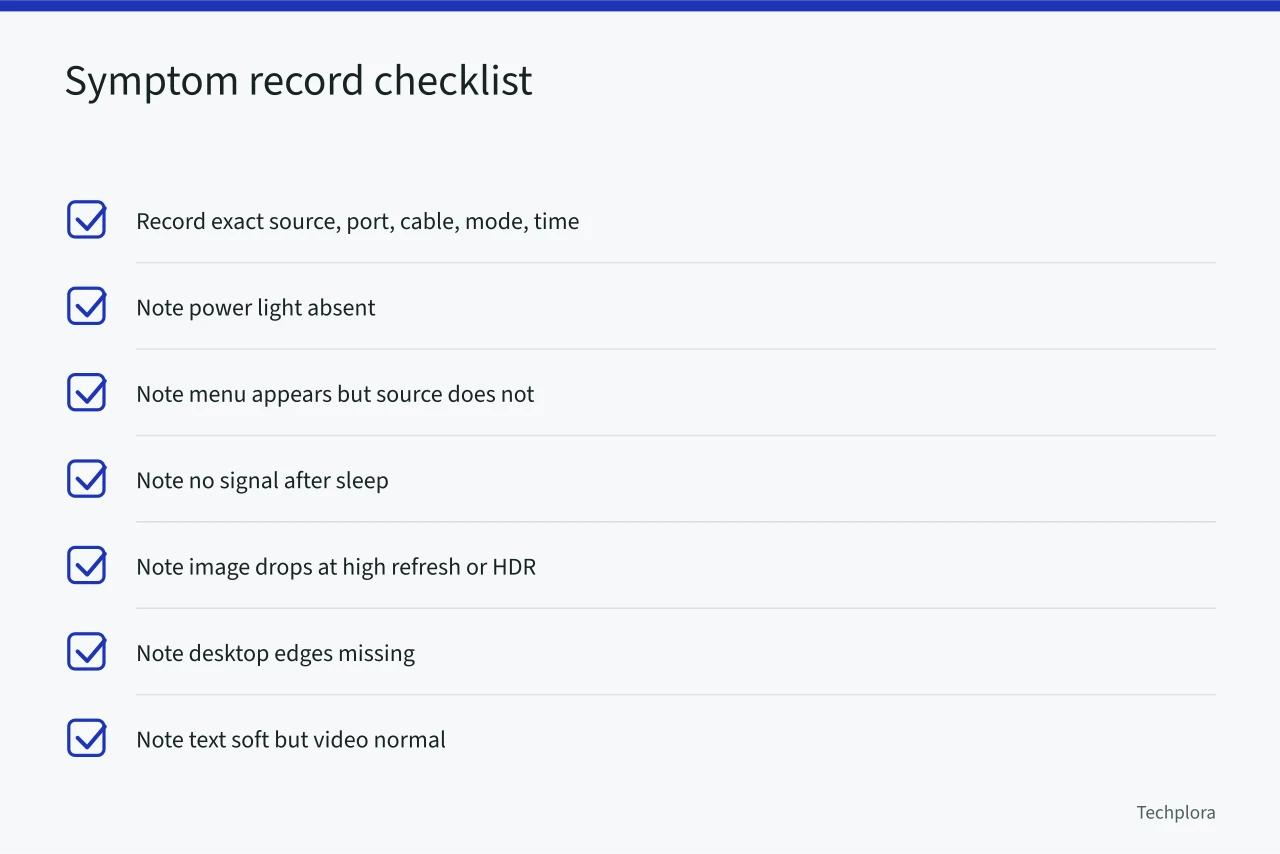
- power light absent
- menu appears but source does not
- no signal after sleep
- image drops only at high refresh or HDR
- desktop edges are missing
- text is soft but video is normal
- color is tinted or limited
- backlight is on but the image is faint
- vertical line remains on menus and every source
- over-the-air channels disappeared after a station change
Photograph errors and record whether sound continues. Note updates, moves, storms, new cables, docks, consoles, receivers, or settings that preceded the fault.
Establish a direct baseline
Turn off the source and display. Remove docks, splitters, switches, receivers, converters, and extension cables. Connect one known-good source directly to a known compatible display input. Seat both ends firmly without forcing them. Select that input manually and start at a common supported resolution and refresh rate.
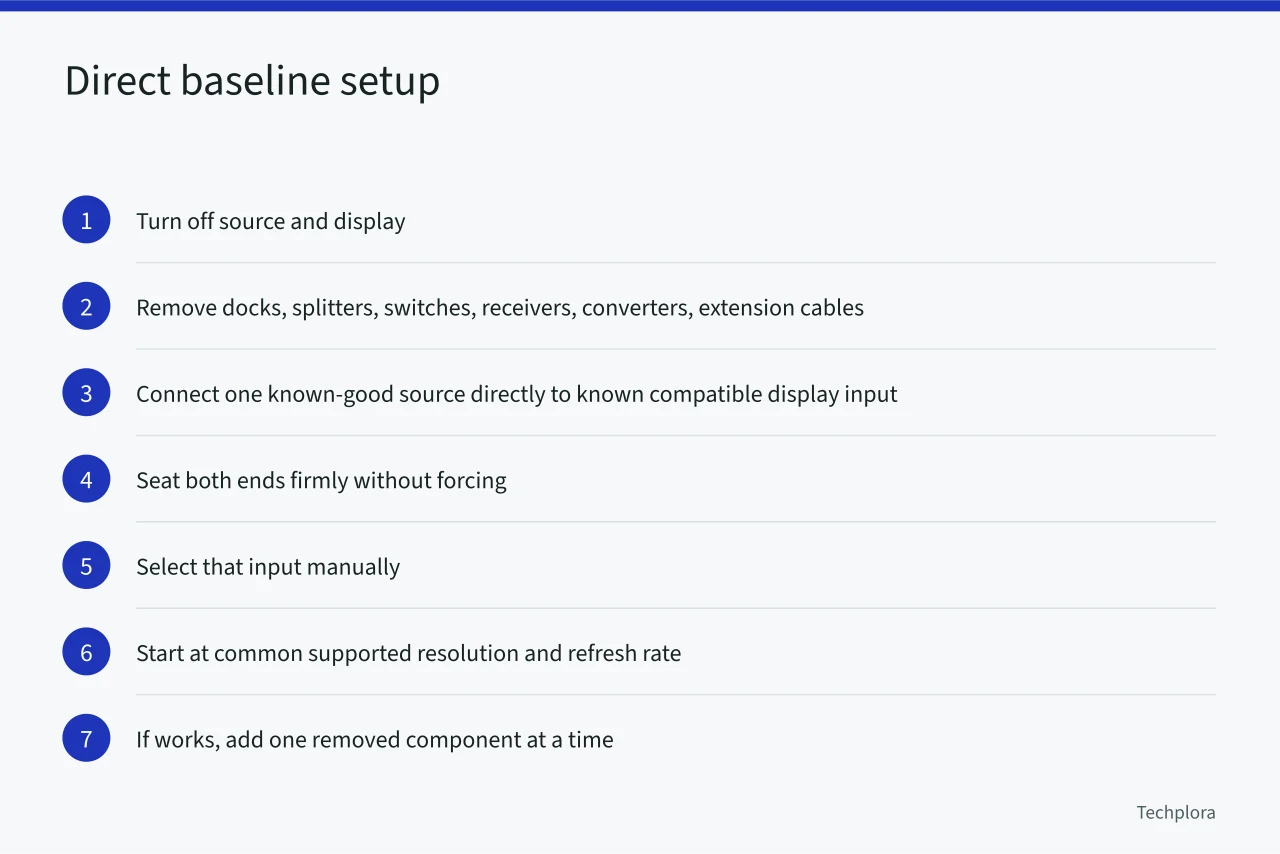
If the display works, add one removed component at a time. If it does not, test the cable with another known-good pair, the source with another display, and the display with another source. This creates three independent questions instead of one vague system failure. The monitor and television setup guide is where that known-good baseline gets written down.
Wikipedia's page on HDMI helps explain why the direct baseline matters: the standard spans several versions and cable categories, ports and extenders differ in what they carry, and protected content depends on HDCP support along the whole path. A signal that fails through a dock or splitter can therefore succeed when the source and display talk directly.
Use the display's own output
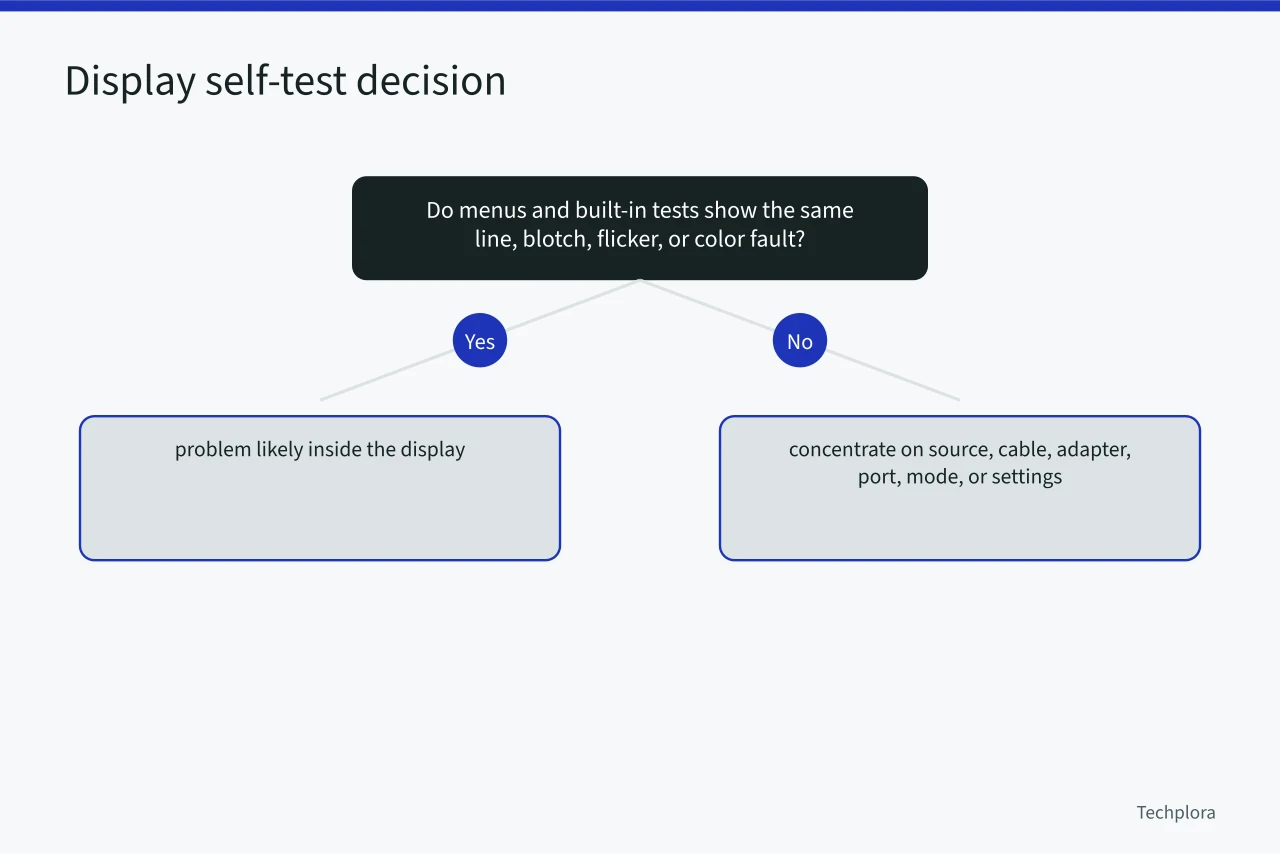
Open the on-screen menu with all sources removed. If menus and built-in tests show the same line, blotch, flicker, or color fault, the problem is likely inside the display. If internal material is clean, concentrate on the source, cable, adapter, port, mode, or settings. The used monitor and television inspection checklist runs the same split before any money changes hands.
Check the exact manual for a self-test. Do not run undocumented service-menu commands. They can change calibration, region, hours, or safety settings.
Reduce signal demands deliberately
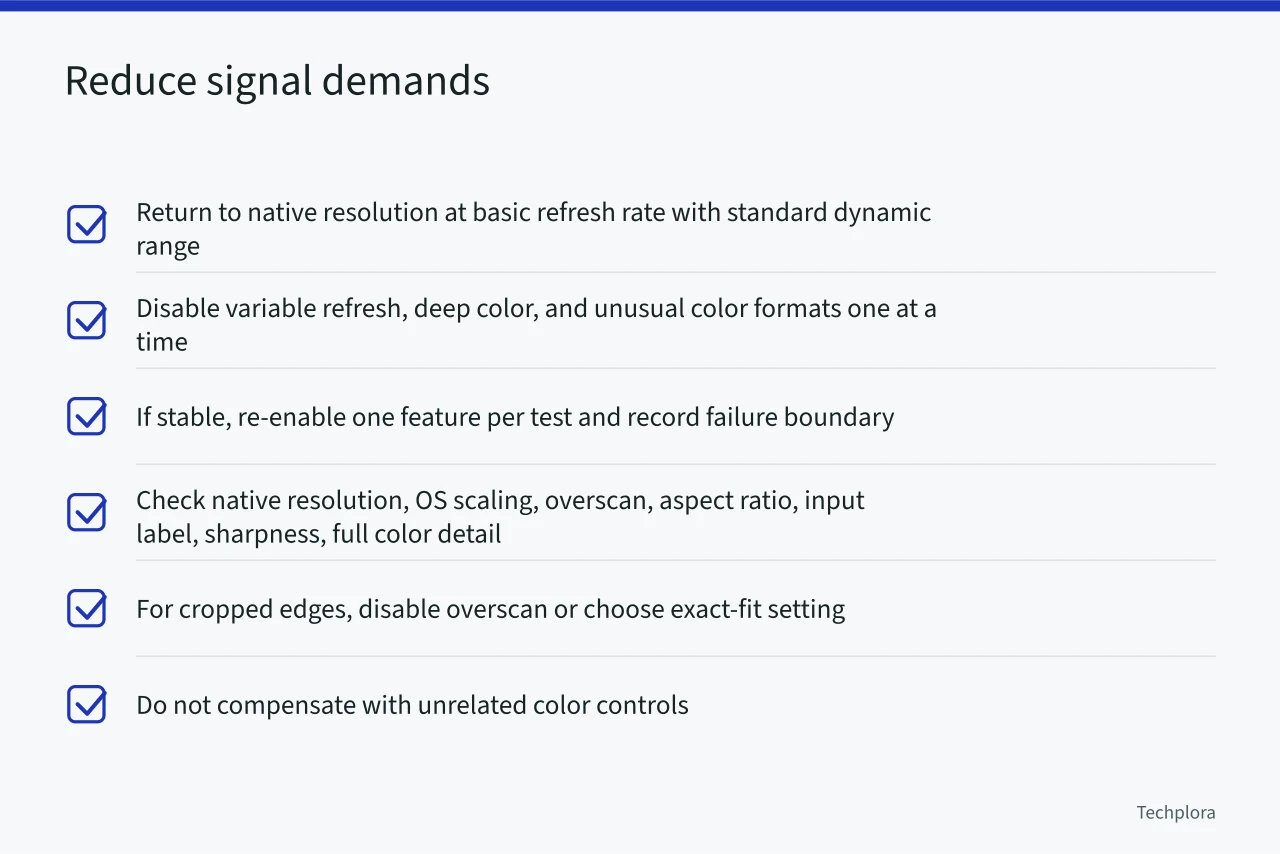
Return to the native resolution at a basic refresh rate with standard dynamic range. Disable variable refresh, deep color, and unusual color formats one at a time. If the image becomes stable, re-enable one feature per test and record the failure boundary.
A cable can pass a lower-bandwidth mode and fail a higher one. An adapter may support video but not the desired resolution, refresh, HDR, or protected content. Cable length, passive versus active conversion, source output limits, and port-specific features all matter.
For blurred desktop text, check native resolution, operating-system scaling, overscan, aspect ratio, input label, sharpness, and full color detail. For cropped edges, disable overscan or choose an exact-fit setting. Do not compensate with unrelated color controls. If soft text persists on a television desktop, the monitor versus television comparison explains why.
Diagnose flicker, lines, and intermittent blanking
Test at another refresh rate and with adaptive refresh off. Remove nearby suspect power or radio equipment. Check whether the fault follows a cable, source, port, or display. Allow a full warm-up and test after sleep because temperature and state transitions can change behavior.
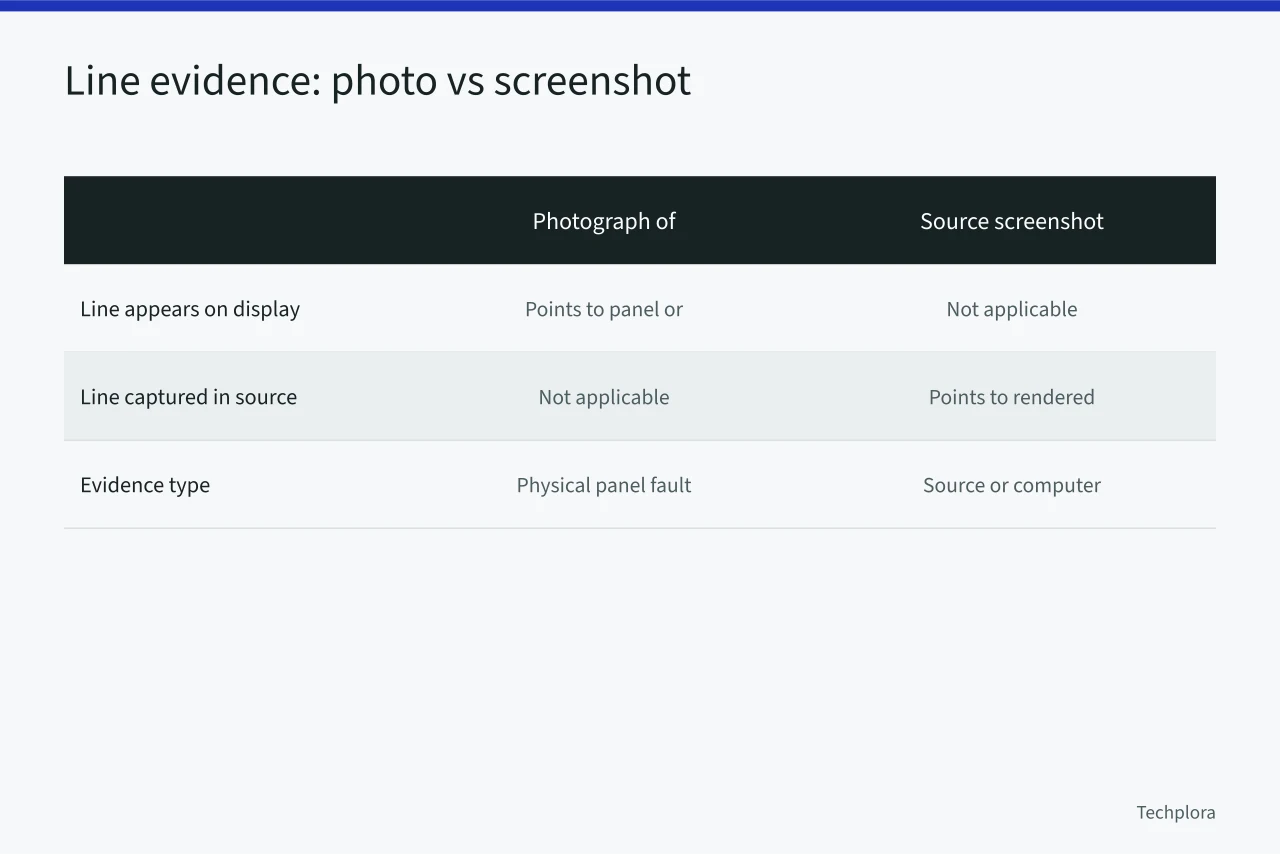
A stationary line that appears on the display's own menu and self-test points toward panel or internal electronics. A line captured in a source screenshot points toward rendered content or the computer rather than the physical panel. A photograph of the screen and a screenshot are therefore different evidence.
Diagnose television reception separately
If streaming and HDMI inputs work but antenna channels fail, preserve the distinction. Confirm the antenna connection, selected tuner input, local station availability, antenna type and position, splitters, amplifiers, and a fresh channel scan. Avoid changing picture settings because they do not affect radio-frequency reception.
The FCC's digital television reception map estimates available signals for a location and warns that predictions assume an outdoor antenna 30 feet above ground while indoor reception can vary widely because of buildings, trees, terrain, weather, and receiving equipment. Treat the map as planning evidence, not a guarantee at one indoor antenna position.
Move or rotate an indoor antenna in small controlled steps and rescan only when appropriate. Record the result by station. Too much amplification can also cause problems, so do not assume more gain is always better.
Resets, updates, and service
Save picture settings, channel lists where possible, account details, app sign-ins, and photographs before an update or reset. Use only the manufacturer's documented firmware route and stable power.
A factory reset removes configuration and connected accounts but cannot repair a cracked panel, failed backlight, burned connector, or damaged power board. When the hardware is gone, the monitor and television buying guide takes over.
Seek service when safety concerns exist, internal tests fail, the fault appears on every source and menu, ports are physically loose, or controlled substitution cannot establish a stable baseline. Give the repairer the model, serial, fault log, photos, cables tested, modes tested, and whether personal accounts remain on the device.
Common questions
Why does my display work at 60 Hz but fail at a higher rate?
The source, port, cable, adapter, dock, or display may not support the higher mode together. Test each element against documented limits.
Does a no-signal message mean the panel works?
It proves that some display functions operate, but it does not test every pixel, backlight area, port, or internal circuit.
Can a factory reset fix a vertical line?
Only if settings or software caused it. A line present in internal menus and self-tests is more consistent with display hardware.
Why did antenna channels disappear?
Station changes, antenna movement, cable faults, splitters, weather, buildings, tuner settings, or a needed rescan can all contribute.