Rules
How to Dispose of a Swollen Phone Battery Safely
Swollen phone battery disposal follows US hazardous waste rules, so here is who has jurisdiction, what a drop-off must disclose, and what happens if you bin it.
What to take away
- A swollen phone battery is a damaged lithium-ion cell, not ordinary trash, and most US states bar it from curbside bins and landfill.
- The EPA points households to certified recycling and retailer take-back, not the municipal waste stream.
- A compliant drop-off tells you who holds the battery, how it is packed, and where it goes next.
- Retailer take-back is the fastest route for one phone; county household hazardous waste events handle bulk.
- Fines for putting lithium batteries in the trash are set by state and city law, and they are real.
Who has jurisdiction over a swollen phone battery
No single US agency owns every swollen battery. The Environmental Protection Agency sets the federal frame for used lithium-ion cells under the Resource Conservation and Recovery Act. States then run their own hazardous waste programs, and many are stricter than the federal floor.
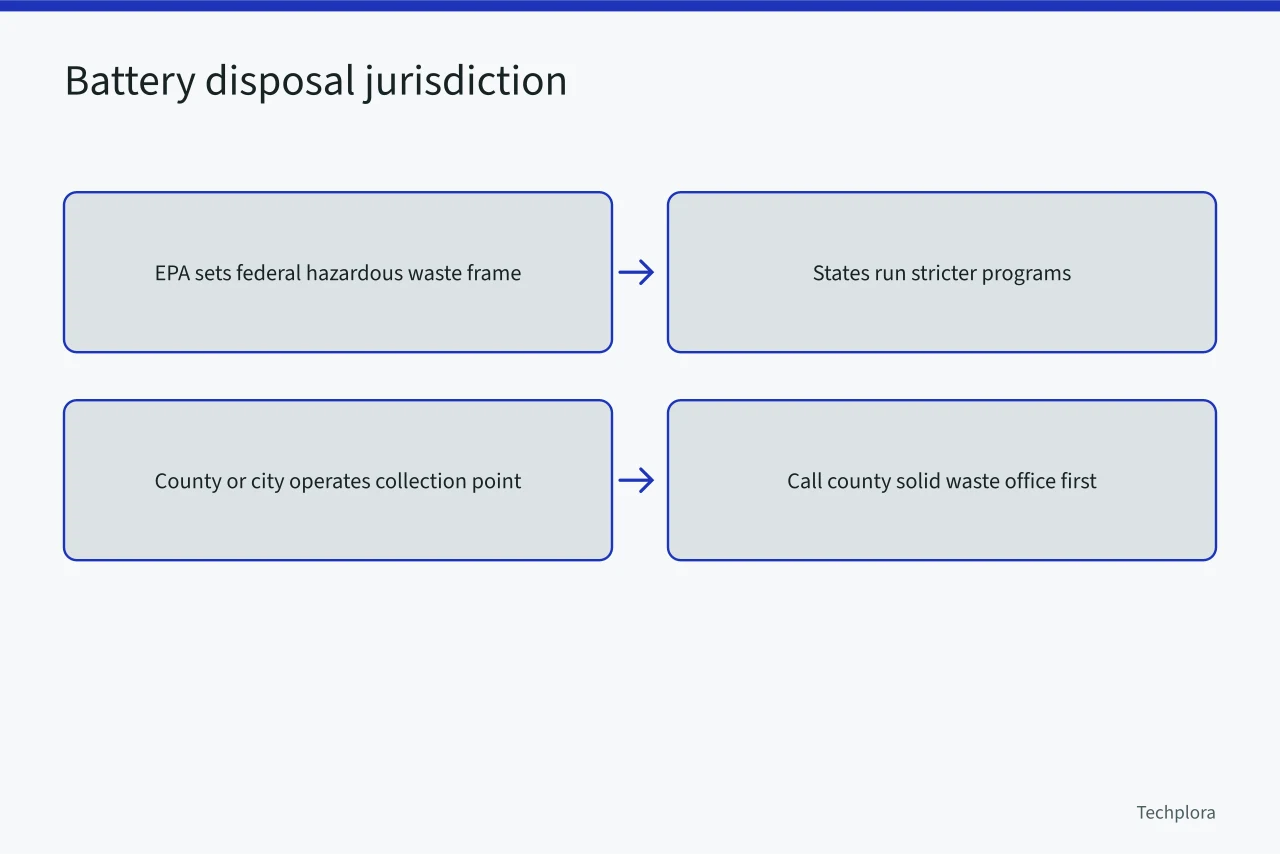
Your county or city usually operates the actual collection point. California, for example, requires battery retailers to accept used cells, while New York and Washington have their own take-back mandates. Call your county solid waste office first, because the drop-off that serves your ZIP code is the one that matters.
A swollen cell can vent and ignite if it is punctured, bent, or crushed in a compactor truck. That is the reason the trash ban exists.
The chemistry behind the swelling is worth knowing before you handle the phone. Lithium-ion cells generate gas when they degrade or overcharge, and that gas pressure deforms the pouch or can. See the reference on lithium-ion battery chemistry for the failure modes.
What a compliant drop-off must disclose
A legitimate collection site or take-back program should tell you four things in writing, on a sign, a receipt, or its website.
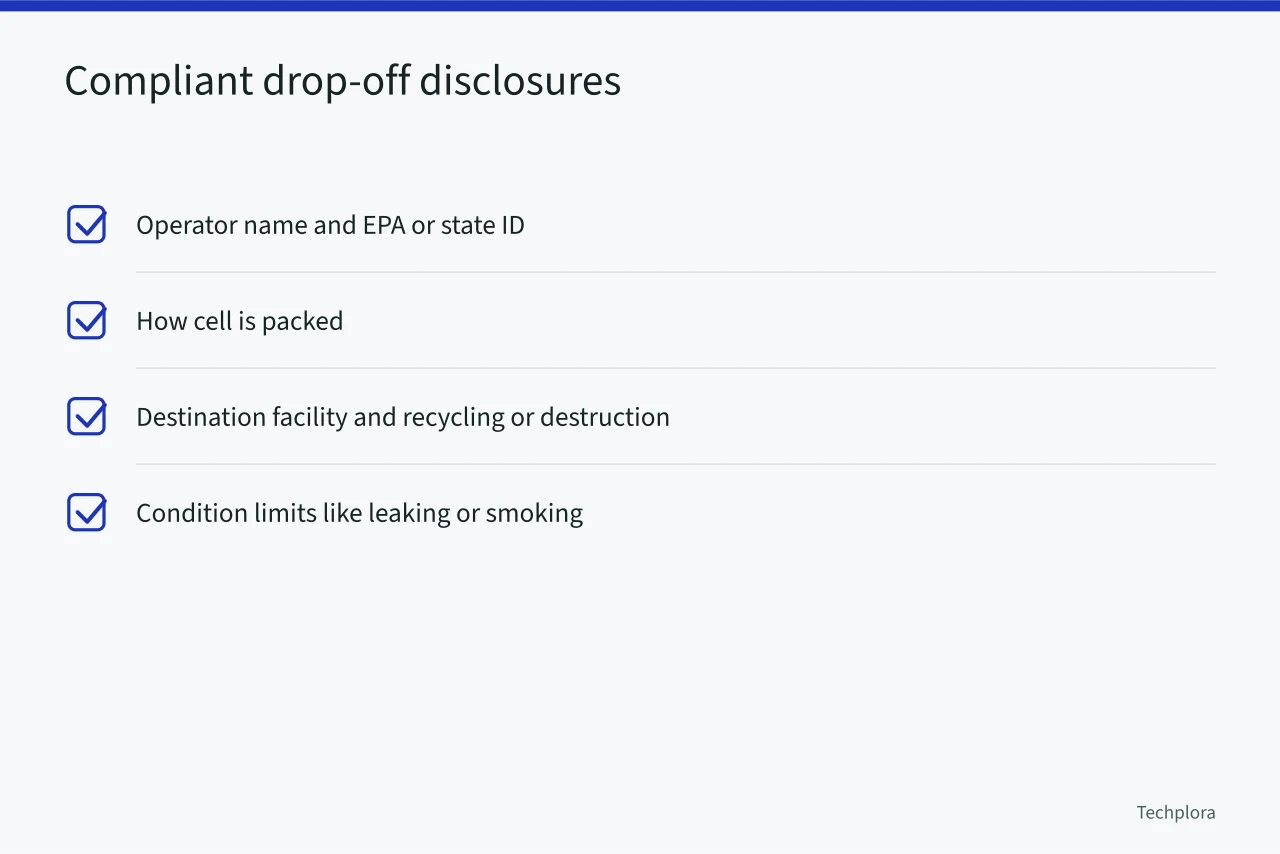
- The name of the operator holding the battery and its EPA or state identification number, where one is required.
- How the cell is packed, typically in a non-conductive bag or a taped-terminal container.
- The destination facility and whether the battery is recycled or destroyed.
- Any condition limits, such as a refusal to accept a cell that is already leaking or smoking.
If a bin has no operator name and no destination, treat it as a black box. Ask the store manager who collects the contents. A retailer that cannot answer is not a compliant handler under most state programs.
Records to keep
Households face fewer record duties than businesses, but two documents are worth saving. Keep the drop-off receipt or a photo of the collection bin with the date. If a battery came out of a device under warranty, keep the repair or replacement record too.
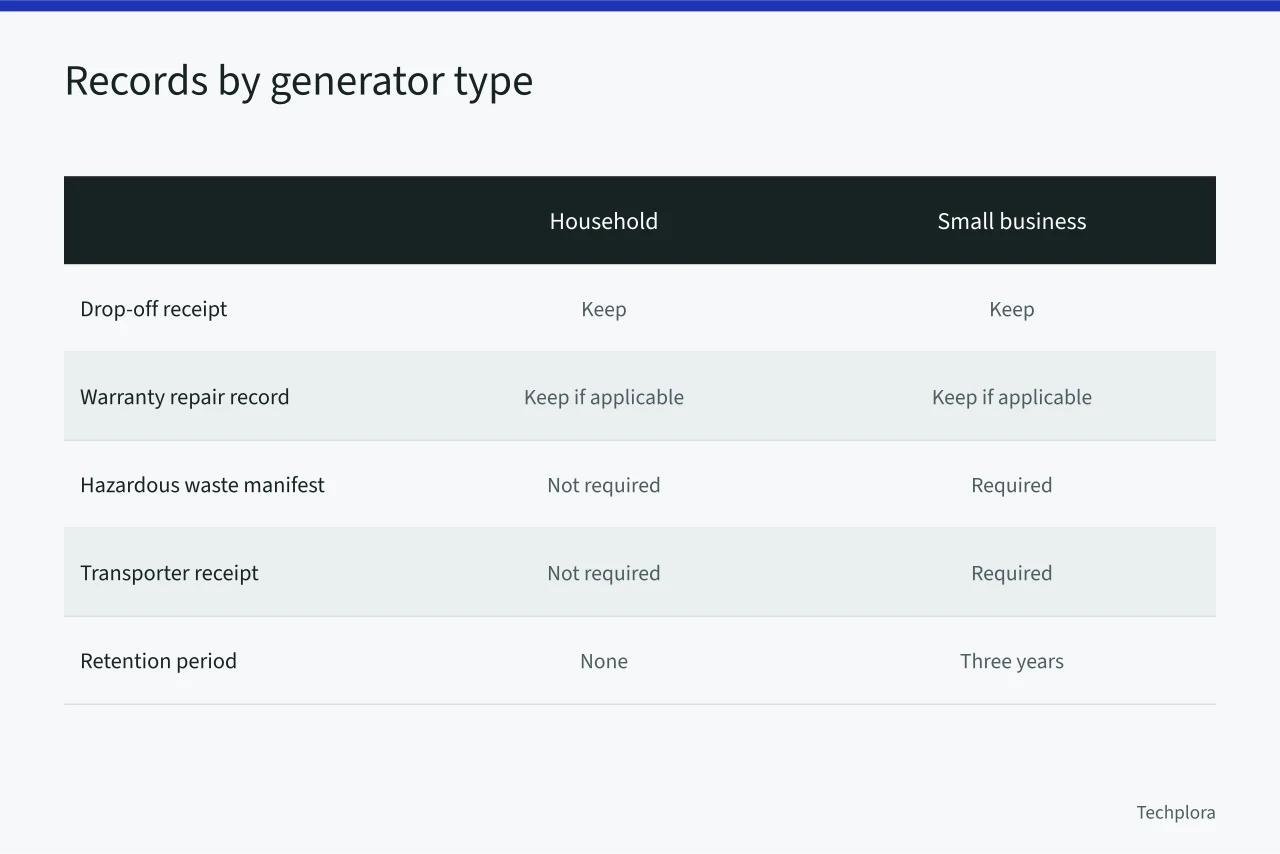
Small businesses and repair shops that generate spent cells carry the heavier paperwork. They typically need a hazardous waste manifest, a signed receipt from the transporter, and records kept for three years under federal rules. If your shop hands cells to a hauler, get the manifest copy back.
What happens if you do not
The concrete consequence is a fine, and in some states a criminal charge. Putting lithium batteries in curbside recycling or trash violates state hazardous waste law in most of the country. Penalties vary by state and city, and they can run into the thousands of dollars per violation for a business.
The second consequence is a fire in the collection truck or the recycling facility. Those fires are why many haulers now refuse carts that rattle with batteries, and why some cities inspect loads.
Where the rules differ by place
Collection access is uneven. Dense metro counties often run permanent household hazardous waste facilities open several days a week. Rural counties may offer one or two collection events a year, so a swollen cell can sit in your garage for months.
Retail take-back fills some of that gap. Big-box hardware stores, phone carriers, and office supply chains accept used cells at the service desk in many locations, though not every store participates. Call ahead and confirm the store takes swollen cells, because a puffed battery is sometimes turned away at the door.
State law changes the options too. Some states require manufacturers to fund take-back, others leave it to counties. Check your state environmental agency page before you drive anywhere. The EPA page on used lithium-ion batteries lists the main routes and warns against the trash.
Handling the phone before you drop it off
Do not charge the phone. Do not press the swollen area to see how soft it is. Put the device in a cool, dry place away from paper, curtains, and anything else that burns, and keep it off carpet.
If the phone still powers on, back up your data now, because the cell may fail without warning. Our guide to phone repair shop OEM parts explains how to check what a shop installs before you authorize a replacement battery instead of disposal.
For a device that is otherwise repairable, replacement is often the better call than scrapping the handset. The right to repair overview covers the state laws that now require parts and manuals to be available, which changes the maths on fixing rather than replacing.
Example: one swollen phone in a mid-size county
A reader in a suburban county finds a three-year-old phone with a lifted back panel. The county runs a hazardous waste facility open Wednesday and Saturday. The phone carrier store two miles away also takes cells at the counter.
The reader tapes the terminals, bags the phone, and drops it at the carrier. The store prints a receipt naming the recycler. Total time: about twenty minutes. No fee at either location, though some counties charge residents a small per-item fee at their own facilities.
Common questions
Can I put a swollen phone battery in the regular trash? No. Most US states classify it as hazardous waste, and haulers treat lithium cells as a fire hazard in trucks and sorting plants.
Will a repair shop take the old battery? Many will, since they already ship spent cells to a recycler. Ask before the repair and get a receipt if you want a record.
What if no drop-off exists near me? Use retailer take-back, or hold the phone in a cool dry place until your county's next collection event. Do not store it in a hot car or garage.
Does a swollen battery mean the phone is finished? Not always. A shop can often replace the cell and restore the handset, which keeps the rest of the device out of the waste stream.