Guides
Prebuilt vs Custom Desktop PC: Which One Is Easier to Repair and Upgrade?
Prebuilt vs custom desktop repairability comes down to standard parts. We compare cases, power supplies, upgrade paths and US warranty terms.
What to take away
- A custom build or a standard-ATX prebuilt uses off-the-shelf parts, so a failed power supply is a swap rather than a hunt.
- Compact and gaming-brand prebuilts often use proprietary motherboards, power connectors and front-panel wiring that limit both repair and upgrade.
- Under the Magnuson-Moss Warranty Act, a US warranty cannot be voided just because you installed a third-party part, though the maker can deny a claim if that part caused the fault.
- Buy for the upgrade path you will actually use: socket, memory slots and case clearance matter more than the sticker price.
The criteria that matter
Repairability is not a feeling. It is a set of physical facts you can check before you pay.
Four criteria decide most outcomes. First, does the case accept a standard ATX power supply, so a replacement is a $60 to $120 part from Newegg or Micro Center rather than a proprietary unit. Second, is the motherboard a standard form factor with a published socket and chipset. Third, are memory and storage slots accessible without removing the whole board. Fourth, does the maker publish a service manual and sell parts to the public.
A fifth criterion is warranty language. The Federal Trade Commission's business guidance on warranty law explains how a full warranty restricts a seller's ability to condition coverage on using their own parts.
The criteria matrix
| Criterion | Custom build | Standard-ATX prebuilt | Compact or gaming-brand prebuilt |
|---|---|---|---|
| Power supply standard | ATX or SFX, widely stocked | Usually ATX | Often proprietary shape and pinout |
| Motherboard form factor | Retail board, documented | Retail or OEM board | Frequently custom |
| Memory and storage access | Tool-free in most cases | Usually accessible | Sometimes under the board |
| Parts sold to public | Yes, many vendors | Often yes | Rarely |
| Typical warranty | 1 to 3 years on parts | 1 to 3 years | 1 to 2 years, unit only |
| Case clearance for long GPUs | Stated in millimetres | Stated | Often tight |
Option by option
A custom build wins on parts availability. Every component has a retail listing, a specification sheet and a warranty that follows the part, not the machine. When a fan fails, you order a fan. The trade is your time and the risk of a build fault that no single vendor will own.
A standard-ATX prebuilt from a business line is the quiet middle. These machines use retail-style boards and standard power supplies, so a technician can service them with stock parts. The ATX standard is the reason this works: it fixes mounting holes, connector positions and power pinouts, which is what makes a 2016 case accept a 2024 board.
A compact or gaming-brand prebuilt is the hardest case. Vendors of these machines have moved toward custom boards, ribbon cables and shaped power supplies. A replacement part may only come from the maker, at maker prices, and only while the model is supported.
Where each one wins
Choose custom if you intend to keep the machine for six years or more and expect to replace the graphics card, storage or cooling at least once. The desktop PC upgrade path is the whole point, and you control it.
Choose a standard-ATX prebuilt if you want a working machine today with a support number, but you still want to fit a new drive or power supply yourself. Business-line towers are the usual answer here.
Choose a compact prebuilt only if size or a specific design is the priority and you accept that repair may mean a return shipment rather than a screwdriver. Read the service terms before you buy, because some warranties require factory service.
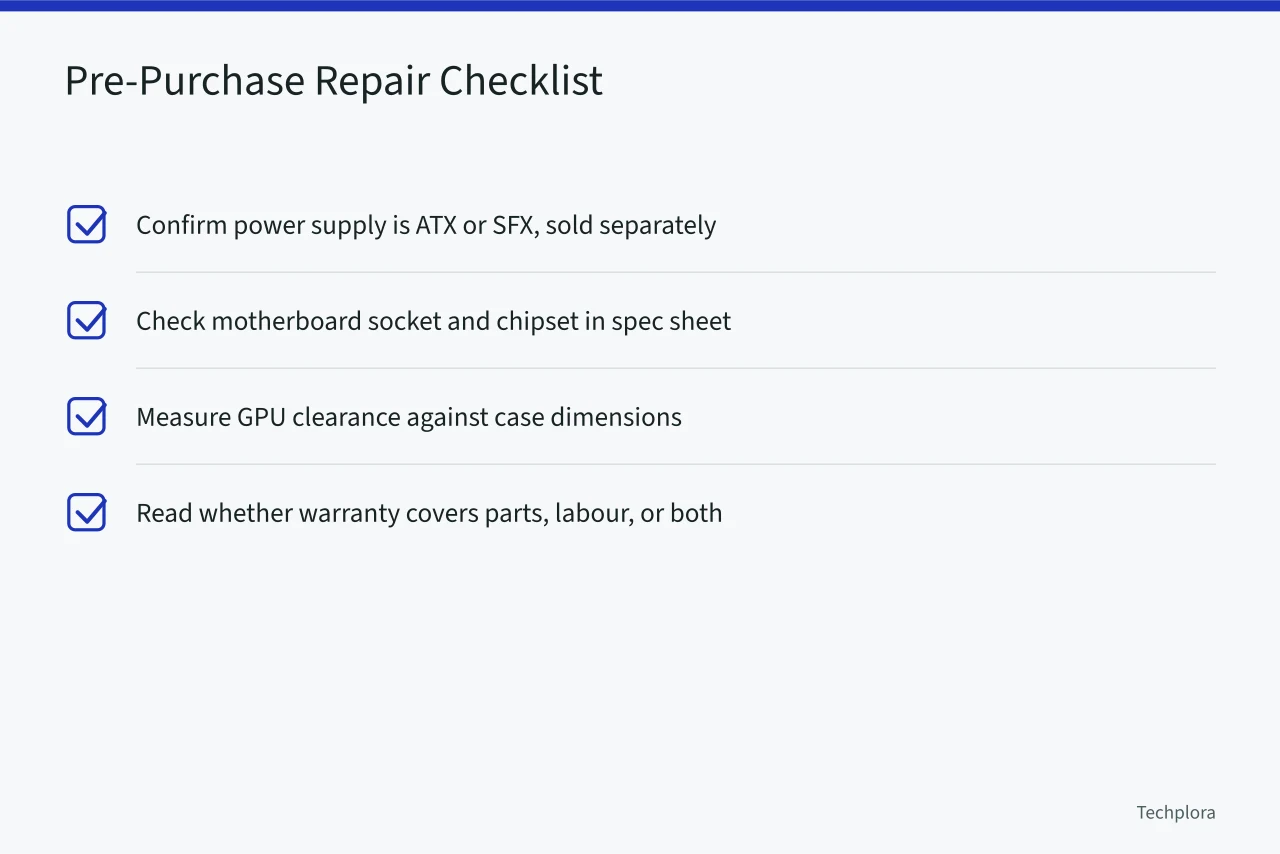
- Confirm the power supply is ATX or SFX and listed for sale separately.
- Check the motherboard socket and chipset in the specification sheet.
- Measure graphics card clearance against the case dimensions.
- Read whether the warranty covers parts, labour, or both.
What none of them solve
No desktop escapes the software side of repair. Firmware updates, driver support and activation can end before the hardware does, and a board that still works may lose security patches. None of the three options fixes that.
There is also a shared limit on data. A drive that fails takes its contents with it unless you kept a copy elsewhere, and the difference between solid-state drives and spinning disks is mostly about how the failure arrives, not whether it does. Plan a backup before you plan an upgrade.
Parts availability is the other shared risk. A socket that is current today may be discontinued in four years, and the resale market is not a warranty. If you are buying for a long hold, favour the platform with the longest published support window.
Example: a five-year-old tower
A reader with a 2019 standard-ATX tower wants a faster graphics card. The case has 330 mm of clearance, the power supply is a 650 W ATX unit, and the board has a PCIe x16 slot. The swap takes twenty minutes and costs the price of the card alone.
The same reader with a compact prebuilt of the same age faces a 240 W proprietary supply, a short card bay and no retail replacement. The practical result is a new machine, not an upgrade. That gap is the entire comparison.
Common questions
Does installing a third-party part void my warranty? Not by itself. Federal law bars a warranty from being voided simply because non-OEM parts were used, though a maker can refuse a claim if it shows the part caused the failure. Keep receipts and the original part.
Are prebuilt desktops always worse for repair? No. Business-line towers and many standard-ATX machines use off-the-shelf parts and are straightforward to service. The problem is specific models that use custom boards and power supplies, so check the specification sheet first.
What should I check before buying a used desktop? Confirm the power supply standard, the motherboard form factor and whether the maker still sells parts. Ask for the service manual, and check the memory and storage slots are accessible without removing the board.
How long should I expect parts to stay available? For standard ATX parts, years, because the format is shared across brands. For proprietary parts, expect support to end when the model line does, which is often two to four years after launch.