Guides
Robot Vacuum Battery Replacement: When It's Worth It vs Buying New
Robot vacuum battery replacement worth it? A US cost breakdown in USD, from a $25 cell swap to a $90 pack, and when a new unit wins on price and runtime.
What to take away
- A replacement pack for most US robot vacuums runs about $25 to $90, and a full manufacturer assembly can reach $120.
- Replacement is usually the cheaper path if the robot is under four years old, parts are still sold, and the rest of the machine works.
- Buying new wins when the battery is one of several failures, or when the model is discontinued and no pack fits.
- Battery packs are recurring costs, not one-offs. Expect to repeat the purchase every two to four years.
- Old packs are lithium-ion and go to a retailer or municipal drop-off, not the bin.
What the range covers
Robot vacuum batteries are sold in three forms, and the price tracks the form. A bare cell pack is the cheapest. A cased pack with a connector adds labor and plastic. A manufacturer assembly bundled with a new dust bin or brush module is the most expensive.
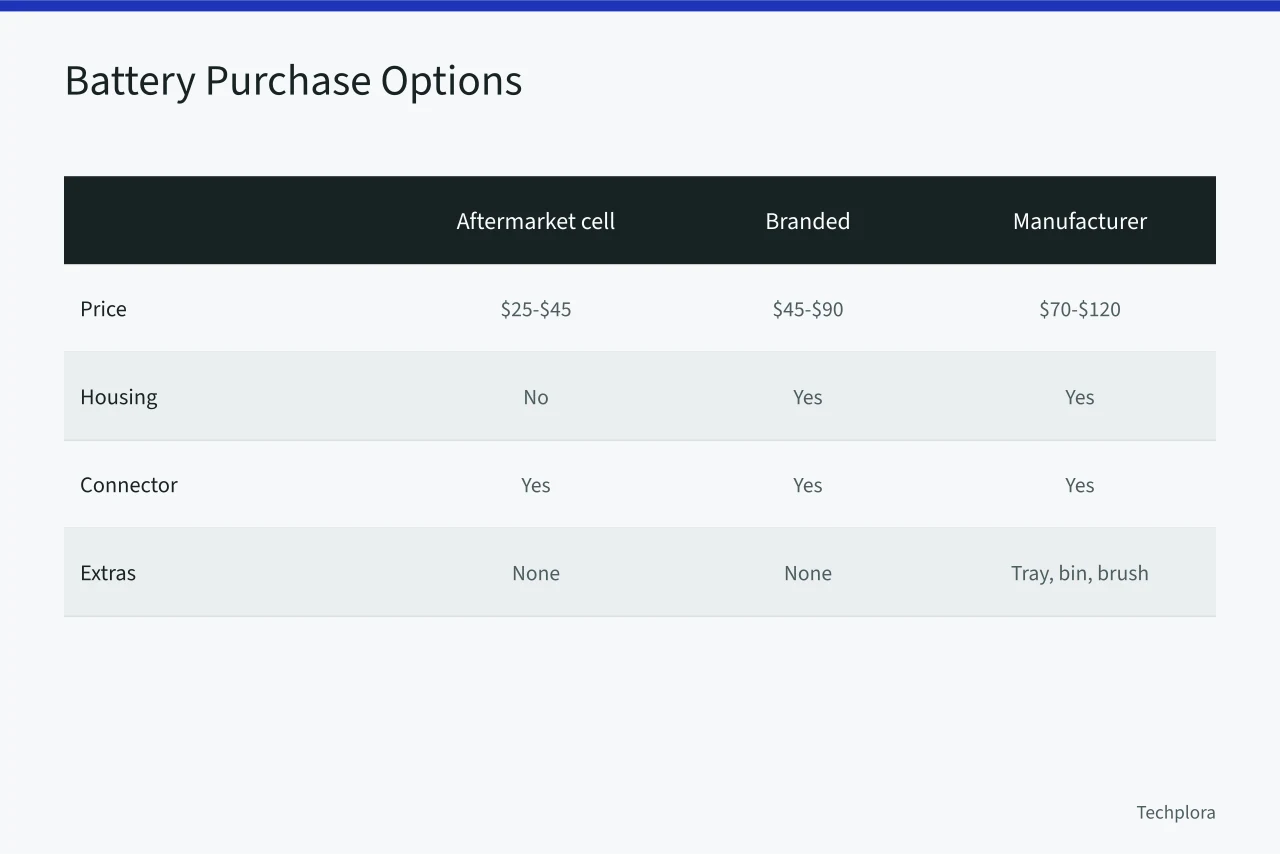
Prices below are illustrative ranges drawn from US listings and parts sellers in 2025. They move with brand, capacity and stock, so treat them as a band rather than a quote.
Show the numbers
| Aftermarket cell pack | $25–$45 |
|---|---|
| Branded replacement pack | $45–$90 |
| Manufacturer assembly | $70–$120 |
The gap between the cheapest and dearest option is roughly five times the entry price. That spread is the whole decision.
Line by line
A like-for-like swap is the common case. You buy a pack, open the underside, unclip the old unit and seat the new one. Tools are a small screwdriver and sometimes a plastic pry tool.
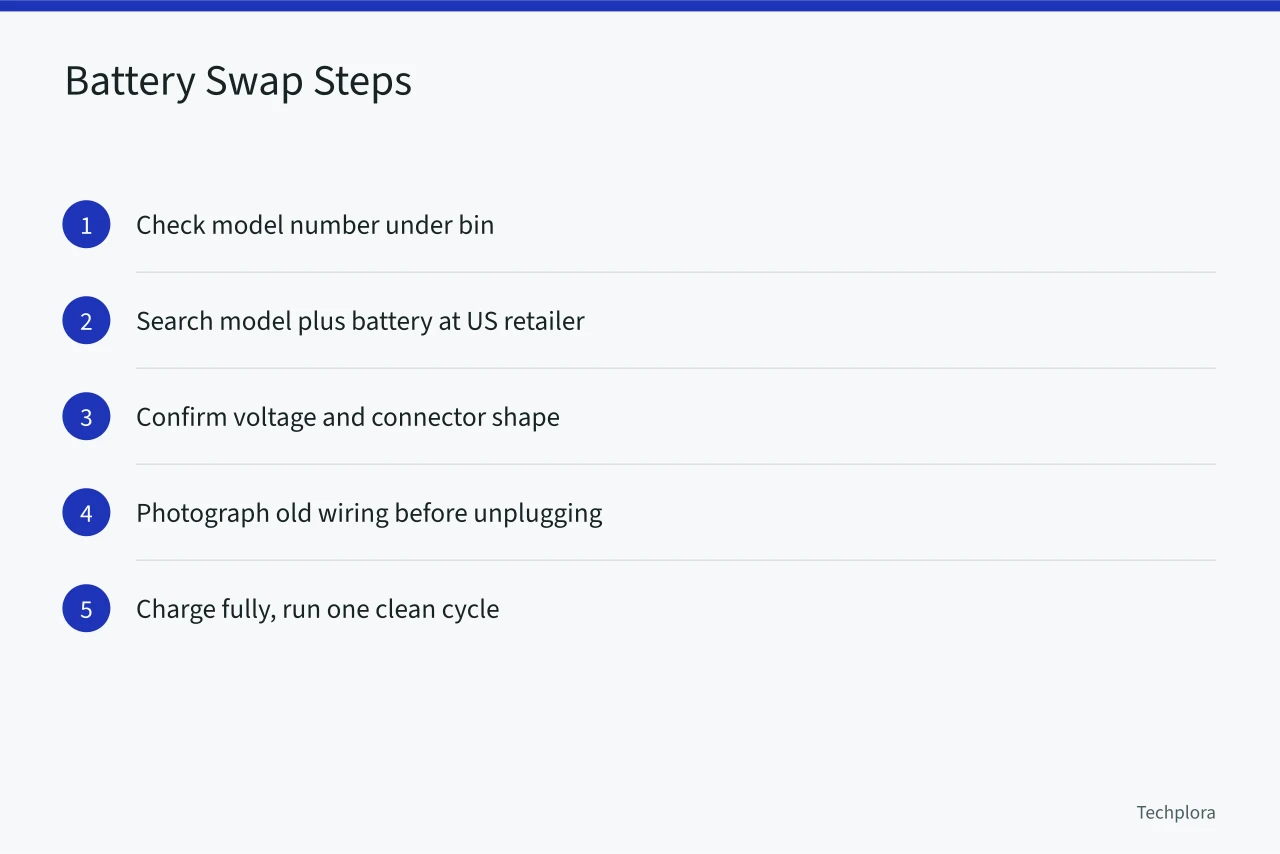
- Check the model number on the label under the bin.
- Search that number plus "battery" at a US parts retailer.
- Confirm voltage and connector shape against the listing photo.
- Photograph the old wiring before you unplug anything.
- Charge the new pack fully, then run one full clean cycle to test runtime.
A service visit changes the maths. Many US repair shops charge a bench fee of $40 to $75 plus the part, which can push a $45 pack past $100 installed. Ask for the fee before you hand over the machine.
The FTC's guidance on warranty law and repair rights explains how using a third-party part can affect coverage, so check the warranty clock before you open the housing on a unit still under protection.
Fixed against variable
The pack is a fixed purchase. Runtime is the variable, and it is the thing that actually degrades. Lithium-ion cells lose capacity through charge cycles and heat, which is why a robot kept on its dock in a warm room fades faster than one stored cool.
That chemistry also drives the safety rules. Swollen packs are a fire risk, and the lithium-ion battery overview covers why cells swell and how to handle them. Stop using a swollen pack and store it away from anything flammable.
Runtime claims are where budgets leak. A pack rated for 120 minutes may deliver 70 in a carpeted room with a running brush. Buy capacity only if your floor plan needs it.
Example
A four-year-old mid-range robot with a $60 pack and a working brush motor is a clear replace. Total outlay stays under $100 and the machine returns to service the same day.
The same robot with a dead side brush, a cracked bumper and a failing wheel motor is not. Add those parts and you are near the price of a new mid-range unit with a fresh warranty.
A discontinued model with no matching pack is the third case. No amount of budgeting fixes a part that is not sold. Check availability before you commit to repair, and read our guide to prebuilt versus custom desktop repairability if you want to see how part availability shapes the same call on computers.
Where budgets leak
Shipping is the first leak. A single pack from a small US seller can carry $8 to $15 in postage, which erases the saving on a cheap cell pack.
Disposal is the second. Old packs do not belong in household trash. The EPA's page on used lithium-ion batteries lists retailer and municipal drop-off routes, and most are free.
Replacement frequency is the third. If you replace a pack every two years on a five-year-old robot, you have spent more on batteries than the machine cost. That pattern is the signal to buy new instead.
The right-to-repair picture matters here too. State laws and parts-availability rules affect how long a brand must stock spares, and the right to repair overview explains what those rules cover for US buyers.
- Confirm the exact model number before ordering
- Price the pack, shipping and any bench fee together
- Check whether the unit is still under warranty
- Verify a pack is actually in stock
- Locate a battery drop-off before you start
A $60 pack on a healthy robot is a repair. A $60 pack on a robot with two other faults is a deposit on a new one.
Common questions
How long does a robot vacuum battery last?
Most packs hold useful runtime for two to four years, depending on cycle count and heat. Runtime drops gradually, so the first sign is usually a robot that returns to its dock mid-job.
Is replacing the battery cheaper than a new robot?
Usually yes, if the pack costs under $90 and nothing else is broken. The gap closes fast once a second part fails or a shop adds a bench fee.
Can I use an aftermarket pack?
Often, yes. Match voltage and connector, and check the warranty position first, since some coverage terms restrict third-party parts.
Where do I recycle the old pack?
Retailer drop-off bins and municipal household hazardous waste sites accept them. Tape the terminals and never place a lithium pack in curbside recycling.