Guides
US Right-to-Repair Laws: What They Mean for Buying Electronics
US right to repair laws electronics affect buying in New York, Minnesota, and California, covering warranty duties and state disclosure rules.
What to take away
- New York, Minnesota, and California require manufacturers to share repair documentation, parts, and tools for many consumer electronics.
- Federal Magnuson-Moss law already blocks warranty terms that force brand-only service unless the brand supplies those parts or service without charge.
- Before buying, check the manufacturer's public service manual and parts catalog for the exact model, not just a general repair promise.
- A noncompliant manufacturer can face a state enforcement action and lose the right to sell in that state.
The federal Magnuson-Moss Warranty Act sets the floor for warranty claims, but state right-to-repair laws add separate documentation and parts duties for electronics makers.
Federal warranty floor
The FTC's Businessperson's Guide to Federal Warranty Law explains that a warranty cannot condition coverage on using original parts or an authorized service provider. The only exception is when the manufacturer provides those parts or services without charge or receives a waiver. This means an independent repair shop using aftermarket parts does not automatically void your warranty.
The federal law is about warranty terms, not a general obligation to sell parts to consumers. It still matters because many electronics makers write warranty language that the FTC would treat as illegal. The right-to-repair movement tracks these state laws and argues for broader parts access.
New York Digital Fair Repair Act
New York's law covers digital electronic equipment such as phones, laptops, and tablets sold after July 1, 2023. Manufacturers must make documentation, parts, and tools available to independent repair providers and consumers on fair and reasonable terms. The law names the New York Attorney General as the enforcer.
A compliant manufacturer will post service manuals, parts identifiers, and diagnostic software for covered models. Use this law as a check before you buy: if the maker does not publish a service manual for the exact model, you may face a parts wall later. For help finding a shop that honors this, see phone repair shop that uses OEM parts.
Minnesota right to repair law
Minnesota's right-to-repair statute covers consumer electronics and certain appliances, and it reaches both independent repair providers and owners. Unlike New York, Minnesota law applies to more product categories and has a broader scope for documentation access. The Minnesota Attorney General can bring enforcement actions.
For buyers, the effect is similar: a product that lacks a public parts catalog or service manual may signal a manufacturer that has not prepared for state compliance. Minnesota's law also interacts with federal Magnuson-Moss because a warranty that still tries to void coverage for independent repair in Minnesota can draw two layers of trouble.
California's disclosure angle
California's SB 244 requires manufacturers of certain consumer electronics and appliances to make repair documentation, parts, and tools available. The disclosure duty lasts for a set number of years after the last date of manufacture. California's law focuses on products sold in the state, and the California Attorney General can enforce a violation.
The key buying signal is a public repair portal. If the manufacturer hides its service manual behind a dealer login or regional restriction, that is a red flag for a California buyer. For desktop buyers thinking about access to standard parts, the prebuilt vs custom desktop PC repairability comparison shows which designs work with state disclosure rights.
What a compliant disclosure contains
A state-compliant manufacturer disclosure is not a marketing claim. It is a set of technical materials that a competent repair shop or owner can actually use.
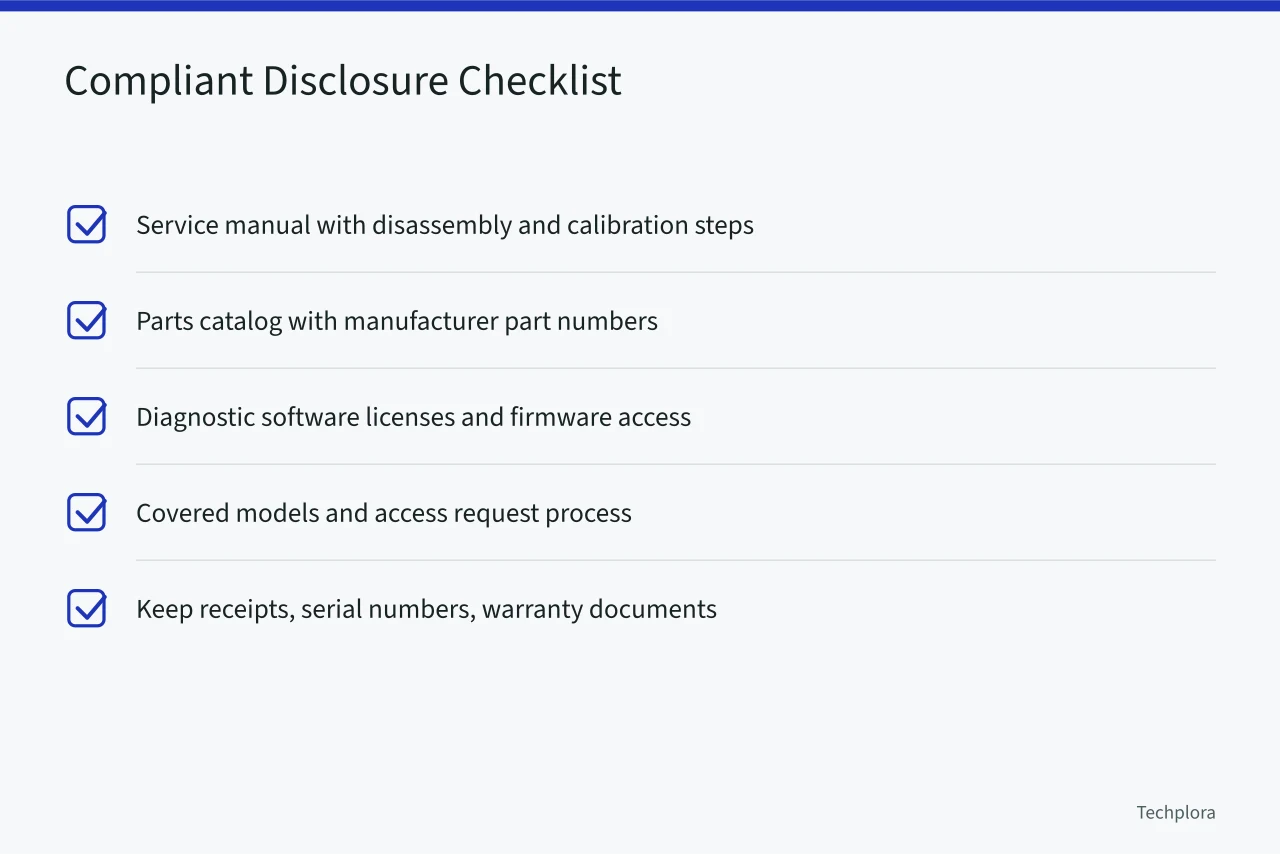
- A service manual with disassembly, assembly, and torque or calibration steps.
- A parts catalog with manufacturer part numbers and an ordering method for independent shops.
- Diagnostic software licenses, firmware access, or security patches needed for safe repair.
- A statement of covered models and how a buyer or shop requests access.
Buyers should keep purchase receipts, serial numbers, and any warranty documents, because a state enforcement complaint may need those records to establish coverage.
What happens if you do not comply
A manufacturer that ignores New York's Digital Fair Repair Act can face a civil enforcement action by the New York Attorney General. A court can order the manufacturer to stop selling noncompliant devices in New York until it provides the required documentation, parts, and tools. That is a concrete business interruption, not a warning letter.
Minnesota and California give their attorneys general similar authority. For a buyer, the consequence becomes an advantage: a noncompliant brand may lose access to a state market, which pushes it to publish manuals and stock parts. If you are weighing a specific repair, the robot vacuum battery replacement guide shows how parts access shifts a buy-versus-repair decision.
Where state rules diverge
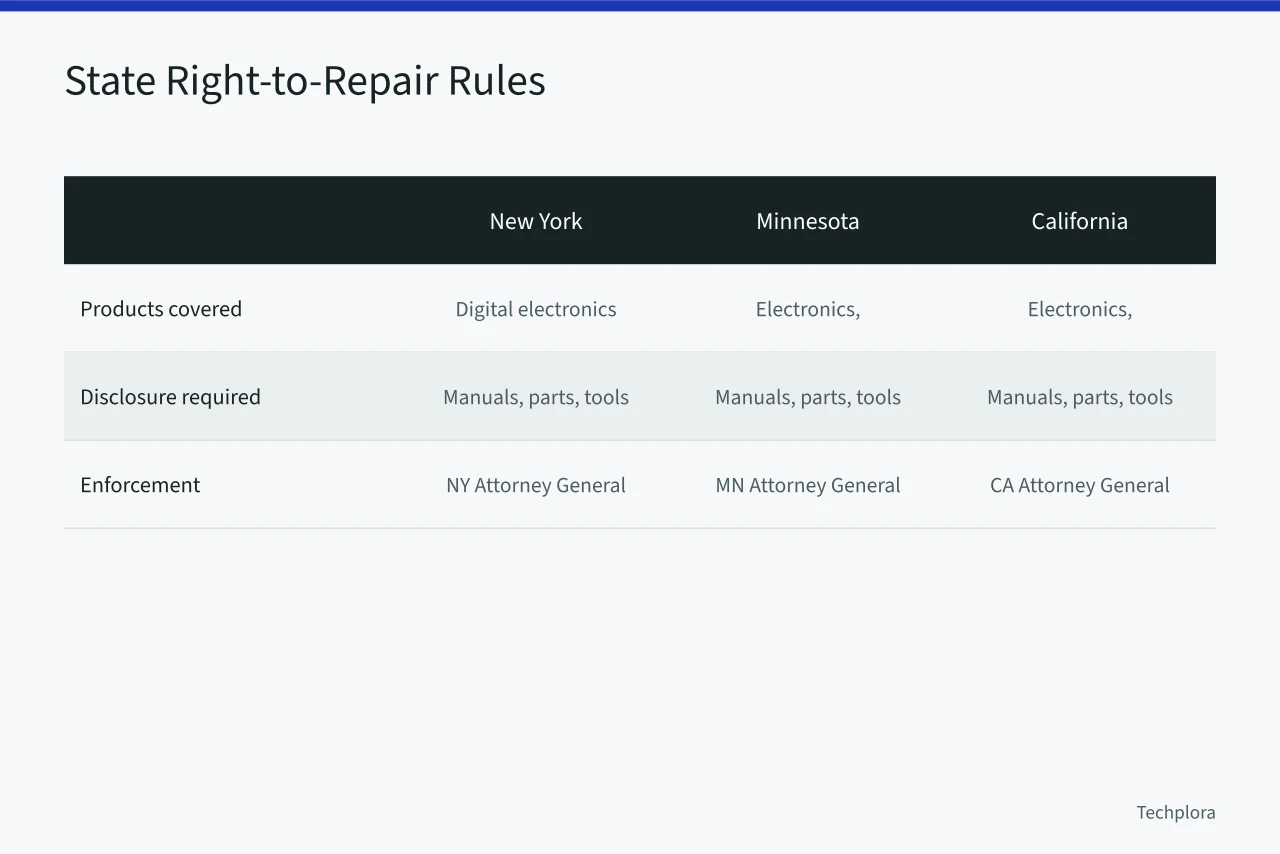
| State | Key products covered | What must be disclosed | Enforcement authority |
|---|---|---|---|
| New York | Digital electronic equipment | Service manuals, parts, tools | New York Attorney General |
| Minnesota | Consumer electronics and certain appliances | Service manuals, parts, tools | Minnesota Attorney General |
| California | Certain consumer electronics and appliances | Service manuals, parts, tools for set periods | California Attorney General |
For a UK comparison, WEEE rules for British households show how disposal rules add another layer to repair obligations.
Common questions
Does New York's law require manufacturers to sell parts to individual consumers? It requires manufacturers to make parts, tools, and documentation available to both independent repair providers and consumers on fair and reasonable terms. The exact rules for end users vary by product and manufacturer.
Will using an independent repair shop void my warranty in Minnesota? No. Federal Magnuson-Moss law already blocks warranty language that requires brand-only service, and Minnesota's law reinforces access to parts and documentation. A manufacturer cannot void a warranty solely for independent repair.
Do these laws apply to appliances like washing machines? New York's law applies to digital electronic equipment, not most home appliances. Minnesota and California cover certain appliances as well.
What records should I keep after buying? Keep the purchase receipt, serial number, and any warranty or repair documentation. These records support a state enforcement complaint if a manufacturer refuses to provide required repair materials.